Whilst I’ve been enjoying the meditative and never-ending process of constructing a scale-model of the Barbican estate’s 123m-tall Shakespeare Tower, I’ve been suffering daily guilt-trips about the lack of streamlining in my studio practice. For example, I spent the first few months of 2026 working on a large-scale oil painting for a show in Deptford’s APT Gallery, now I’m making a tower out of cardboard and then on some days I find myself painting tiny watercolours. The next two months are set to look different yet again as I paint a load of paper pulp reliefs on cardboard for an upcoming solo show in July.
When I’m taking a break from the glue-gun, my nagging inner-critic invariably leads me to look at other artists on social media where I see row after row of neat Instagram grids of similar-looking works, instantly recognisable and coherent. In a moment of madness, I went through my own profile, eliminating anything other than painting as a way of convincing myself – and the world – that I am a serious artist with a highly-developed, coherent body of work.
Whenever I’m able to pull myself away from the glue-gun, the Barbican or my phone, I’ve always been relieved to get into the real world where, thankfully, I am normally buoyed by what I’ve physically seen: artists presenting exciting and interesting work which often strays beyond one medium.
Two exhibitions I have seen recently and which have done this very successfully are Mikey Cuddihy’s solo show at Domobaal and a presentation of the Italian designer Alessandro Mendini at the Estorick Collection, both here in London.
Mikey Cuddihy’s show has used the spaces of Domobaal’s Georgian townhouse to present a varied selection of paintings both on and off the canvas. The first thing you see is a large grey painting which feels quite serious but as you turn the corner to ascend the stairs you’re confronted by two more works, bright and playful and featuring a collaged paintbrush which, in the context of seeing the darker work, feels very funny. Upstairs, in the main space, a framed painting on paper sits beside loose paper cut-outs which appear to be moving away from it like insects, crossing the room’s corners and part-way onto the floorboards. And there’s an interesting assemblage of dark, antique furniture at one end of the room which frames a large yellow painting and some delicate paper fans.
I left the opening event of that exhibition with a spring in my step and cycled over to the Estorick Collection to see the Alessandro Mendini exhibition for no other reason than I really like this gallery and their shows are usually very good. I knew nothing of this post-war designer beforehand but I’m so glad I made the journey over to see it. Both ground floor galleries are crammed full of artworks: textiles, collaged metal heads, ceramic sculptures, hanging banners, paintings and items of furniture in bright, wacky, nonsensical colours.
Seeing all this reminded me why I am such a huge fan of the work of Fortunato Depero and the Futurists: not for their obsession with speed and dynamism, but for the proliferation and variety of work produced and for their desire to radically modernise contemporary society by seeking to dismantle the old hierarchy of the arts which placed painting above design and so-called craft.
The way that this exhibition is curated feels like the full-immersion experience of stepping into Giacomo Balla’s Rome flat or Depero’s northern Italian Casa D’Arte in which everything: clothing hanging on pegs, floor coverings, wall paper and furniture were designed by the artists. Here in the Estorick, it was instantly and abundantly clear that Mendini was hugely inspired by these earlier figures.
Back in the studio, my job has become clear: to stick two fingers up at the harsh inner-critic by spending more time visiting exhibitions like these, reading books and staying off social media. And of course to finish the Shakespeare Tower model which, coincidentally, you’ll be able to see at the exhibition Rock, Paper, Scissors in Walthamstow in June.
National Museums Liverpool at 40 - part 2
Friends know that I love trains and transport. Close friends know that this love extends also to transport design, especially the moquette: the carpet-like, patterned seat coverings found on trains, buses and trams. So I was delighted to have been gifted a pair of yellow and grey trademark Merseyrail socks right at the start of April. I decided that an appropriate outing for their initial voyage would be on board a Merseyrail train into Liverpool from my parents’ place in Aughton Park. Wasting no time, I headed into Liverpool that same evening for the private view of the ‘National Museums Liverpool at 40’ exhibition at the city’s World Museum.
A few weeks earlier, I had received an invite from Kay Jones, Lead Curator in Urban and Community History at Liverpool Museum,informing me that my 2023 Liver Building sculpture – which the museum acquired for their permanent collection later that year – was going on display for ten months. Apart from this invite, I had no idea what to expect or which other works would be included in the exhibition.
My sister and I arrived and were greeted and we made our way up the flights of stairs to the galleries. We listened to the speeches which announced that the exhibition is a commemoration of the past forty years of the museum and as such is a selection of forty objects, chosen by the various curators and some patrons from their four-million-strong collection of objects and artefacts: I was both honoured and surprised to hear that my paper-mache model was one of them.
We went in to explore the exhibition, finding that it is a varied as you’d expect: ranging from a Sickert seascape to the door of the Hillsborough Supporters office. As we glanced around the artefacts, we were approached by a friendly lady who it turns out is a patron and who had been asked to select one of the pieces and which she now introduced us to: a small ceramic bowl from Birkenhead’s Della Robbia Pottery – dating back to between 1894 and 1906 when this local ceramic factory produced pieces inspired by the Arts & Crafts movement and which was founded to emulate the style of the 15th Century Florentine sculptor Lucca Della Robbia, known for his glazed reliefs.
Liverpool is, of course, known for its friendly people and this lady was no exception. I was subsequently invited to attend the high-profile opening party of London’s V&A East, which I was delighted to attend a few weeks later.
For anyone in the North West, the Liver Building sculpture – and the Della Robbia bowl – will be on display until February 2027.
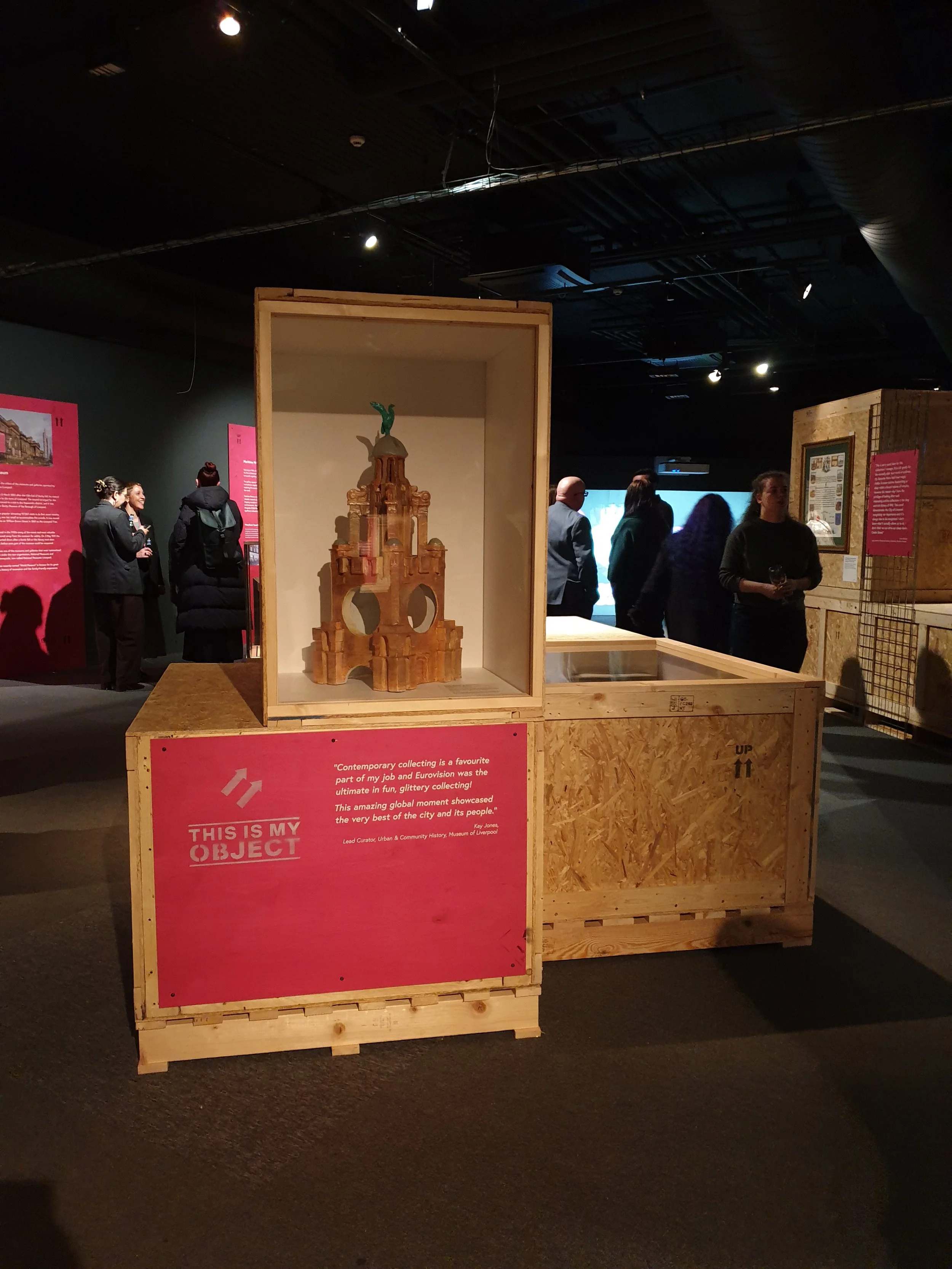
The Liver Building sculpture on show in Liverpool’s World Museum