At the end of last year I moved into a new studio in the former Percy Dalton’s Peanuts warehouse. My ninth in nine years in London, I’ve become used to life as an artistic nomad in the drive to keep things cheap and so I don’t have to spend too much time away from the studio in paid employment. My new studio, totally free of charge, is one of the biggest and best to date with huge windows, high ceilings, wifi and access to kitchens and bathrooms and is being generously leant to me whilst my friend Anna takes maternity leave. This sees me return to Hackney Wick which I first visited in 2005 when art school friends Alex, Lucy and Rob moved here after we all graduated. I still remember taking the Tube to Highbury which itself felt like the end of the world before taking a battered old Overground train even further beyond. Totally transformed now beyond recognition, the old Peanut Factory where I’m based is surrounded by new builds and towering cranes.
The Hacienda
In 2017 I set myself the goal of getting one hundred rejections. This came after a period in which I was becoming horribly demoralised by months of unsuccessful applications and the usual emails which begin Dear Artist... The idea itself was nothing new: I stole it from author Stephen King and his book On Writing. Despite my good intentions (it seemed like an easy task, after all) I found that by the end of the year I had been unsuccessful even with this – only managing a mere 76. I consoled myself with the fact that 76 rejections also meant 76 applications in the first place and I eventually congratulated myself for this.
In the years that followed, it turned out that 76 would be the greatest number of applications possible for me in one calendar year: the annual number diminishing all the time. That is until this year – today is January 10th and I have already had my first rejection of the new year which pinging into my inbox this morning. This year is looking positive: perhaps my rejection mojo has returned.
Maybe, however, personal rejections will become a thing of the past for me. Last year, I set out on three trips to southern Spain: two with the intention of finding a cheap property which I could use to set up my own residency programme. Motivated by some of my happiest and most productive times, which have often been as a participant on various residency programmes, I figured, ‘why not run my own programme so I can live like this permanently?’ These trips helped me to clarify three things:
1) Inland southern Spain is beautiful with vast landscapes.
2) Properties are plentiful and wildly varied.
3) Artists would love it here.
Nonetheless, nagging questions filled my mind. Would I be able to run something like this? Would leaving London be career suicide? Would I be creatively shooting myself in the foot? The answers to these questions can’t actually be answered without trying and I have been taking inspiration from figures like Manchester’s Tony Wilson – the creative pioneer whose legendary status has continued posthumously and whose Hacienda nightclub famously made enormous financial losses. Maybe failure is ok.
This situation is still playing out so 2026 will likely reveal what happens next. If you’re interested in being one of my pioneering resident artists or collaborators, get in touch.
Italian Futurism and north-west Absurdism
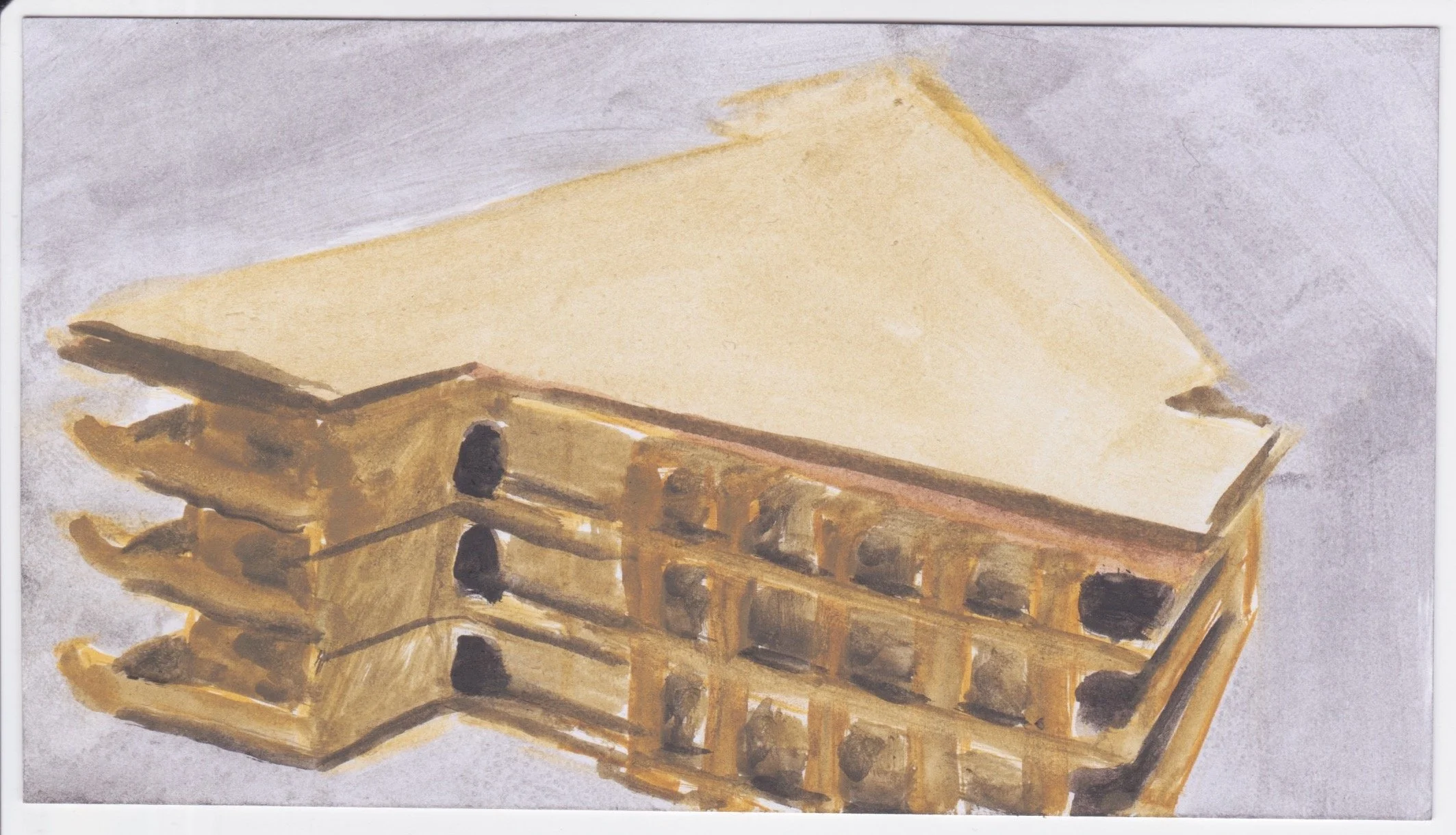
As I transitioned from my former studio –a friend’s double garage in Walthamstow which I was also able to use free of charge – I began something new: a cardboard copy of Italian Futurist Fortunato Depero’s 1932 tapestry ‘Il re di denari’ which I first saw during my three months at the British School at Rome at an exhibition in Florence’s Palazzo Medici-Riccardi.
I have often found the transitions between different studios to be creatively quite challenging so it made sense to get my hands moving using materials I know well: cardboard and glue. This work of Depero’s was an obvious choice for me as it presents one of the pinnacles of his career: a masterclass of economy in terms of the forms and colour which uses a limited palette and various repeating motifs from which the whole artwork takes shape.
Coincidentally, the phrase ‘The use of repeating motifs’ is a line I hear myself recalling every day at work in my role as architecture tour guide around London’s Barbican Centre. Having now worked here for eight years (not always as a tour guide) I have come to love the estate: the whole 40-acre site a giant work of art, what the German’s call a gesamkunstwerk. Simple forms make up the buildings and four motifs dominate: the semi-circle, the Egyptian cartouche, stepped Crennelations and Modernist arrow loops. The economy and scale of the whole place is astonishing and I could learn a lot from Chamberlin, Powell and Bon the estate’s architects. To this end, I’ve began to construct a replica of one of its iconic towers: the Shakespeare Tower.
When Eurovision came to my home city of Liverpool in 2024 I had no hesitation in marking this occasion by making a replica of its most famous buildings, the Royal Liver Building, which I proudly wore over my head as the hot May sun beat down on the packed city’s streets. An extension of this, my Shakespeare Tower is also wearable and will likely be linked to some sort of performative event down the line.
On my last trip of the year, to Spain at Christmas, I spent a good deal of time watching videos of papier-mache-headed Frank Sidebottom larking around Timperley in Cheshire: giving guided tours from the top deck of double-decker buses, climbing into garden centre ponds filled with koi and hosting guests on his Fantastic Shed Show. I also spent time listening to John Shuttleworth and his absurd keyboard tunes.
Upon my return to London last week I spent a happy evening at London’s Museum of Comedy where friend Paul Haworth was on stage as his alter-ego Pop Daddy. Hilarious and ridiculous, links formed in my mind between Sidebottom, Shuttleworth and Pop Daddy: all from the north-west and all inspirational in the development of my 3D work.
From Anagnina to Battistini
A single painting of an isometric Casio watch face rendered in Pthalo blue marked my last painting of 2025. Adjacent to this was the digital plan for a new largescale painting I am about to make. During my time at Turps Art School I often found myself under fire for lack of planning when it came to my paintings and I’ve worked hard to combat this through smaller studies and digital mock-ups so that when it comes to painting the work itself, the thought process is complete and I can get lost listening to Italo Disco and podcasts.
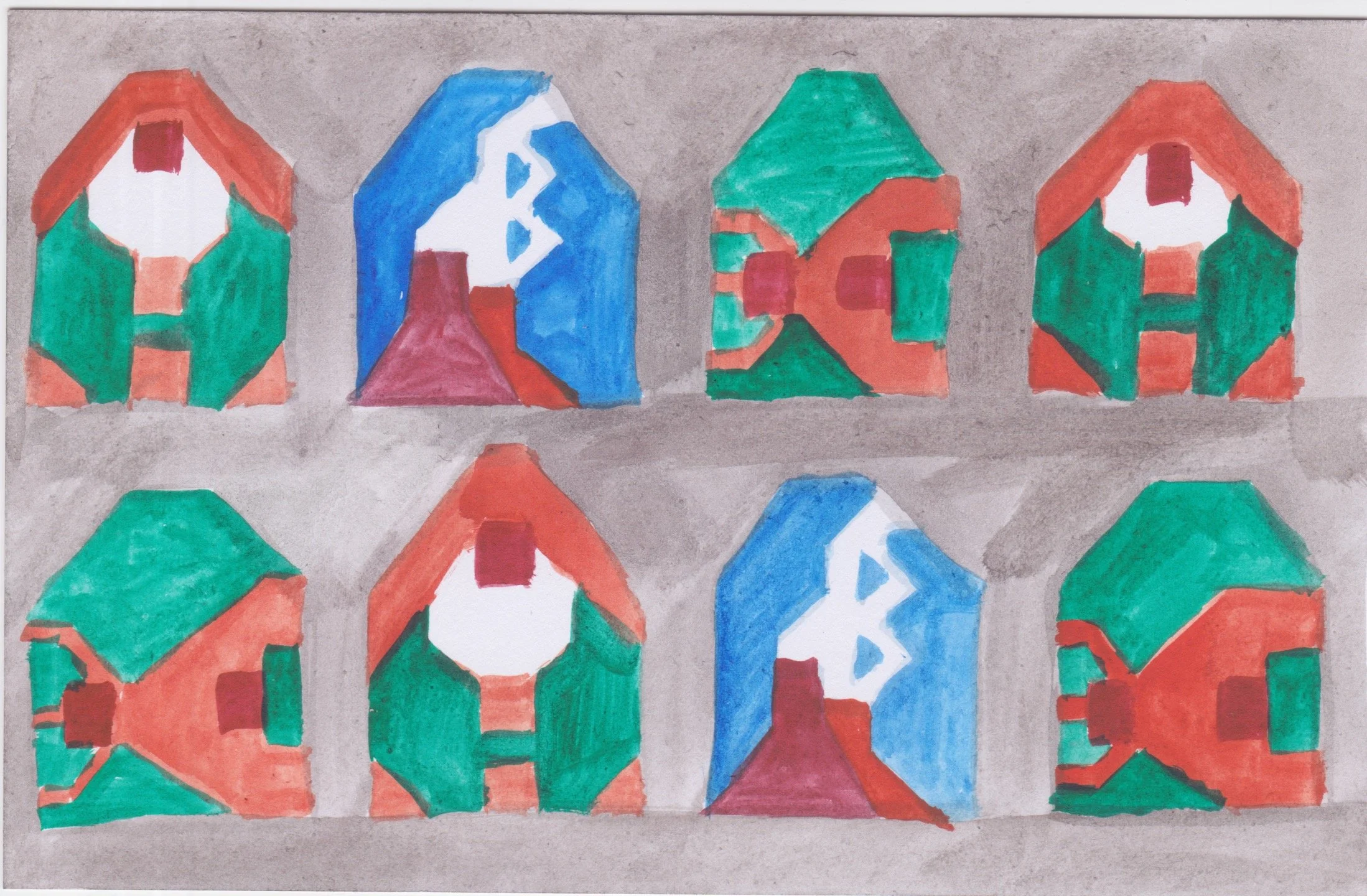
This latest work is scheduled to be included in a group show, Ex-Roma VI at APT Gallery in March and will showcase the last three years of Abbey Award fellows and scholars from the British School at Rome. The painting itself is an extension of my previous painting series in which I made giant triptychs of travel books I’d like to write, painted isometrically. My new work, From Anagnina to Battistini operates as a travelogue in which I travelled to every station on the Rome Metro network. Alongside the title and author’s name, spelled out in glitchy LED arrays, it features an array of tessellated Casios and the moquette which I designed specifically for the seats of the Rome rolling stock: stylised A, B and C letters which reflect the three lines in a repeated grid.